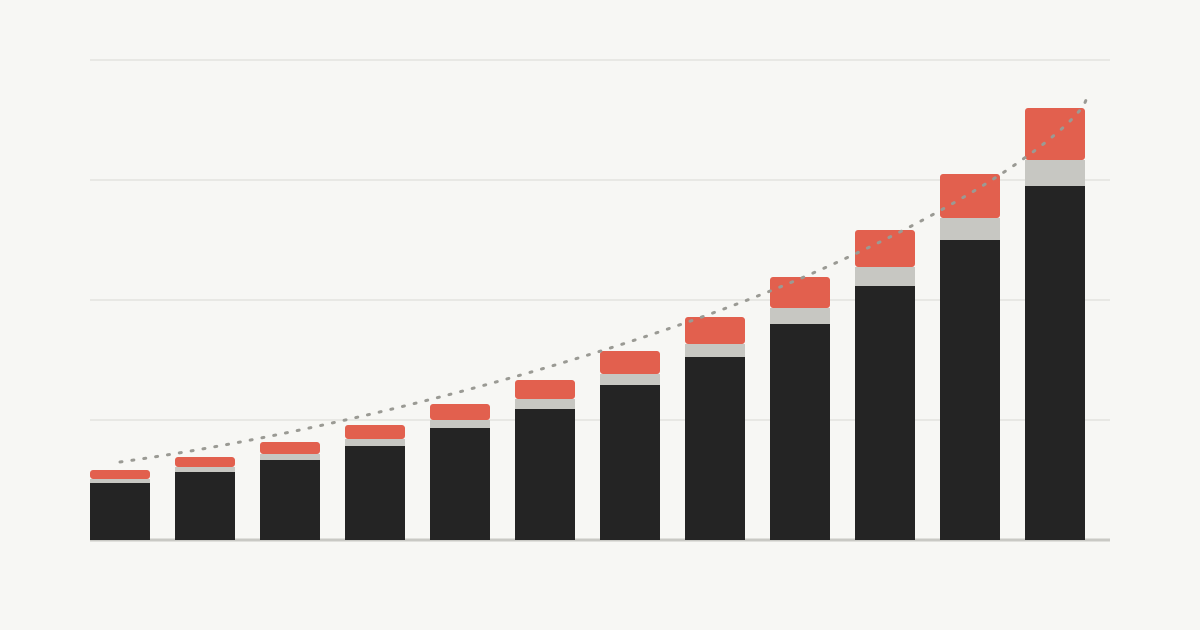
The Hidden Tax Drag Inside Your Super Fund
If you’re in an industry or retail super fund, there’s a tax you’ve been paying for years that has never appeared on a statement: capital gains tax on assets that haven’t been sold. It’s baked into your fund’s unit price, and the bill is settled — quietly — on the day you move into pension phase.
Here’s how the mechanics work, and why I built the Super Calculator to put a number on it.
How unit prices work
In a pooled fund, you don’t own shares — you own units. The fund owns the assets, and every day it computes a unit price:
unit price = (assets − liabilities) ÷ number of units
The subtle part is in liabilities. The fund knows that one day it must sell its assets and pay capital gains tax on the profits, so accounting standards require it to count that future tax bill as a liability today — a deferred tax liability on gains that haven’t been realised.
A simplified example. Say your share of the fund’s assets is worth $500,000, of which $200,000 is unrealised capital gains. With super’s 15% earnings tax and the one-third discount for assets held over a year, the effective CGT rate is 10%. The fund provisions 10% × $200,000 = $20,000, and your units are priced as if you held $480,000.
So as the market rises, your unit price rises by a little less than your share of the gain. The tax hasn’t been paid — no asset has been sold — but you can’t access the full value either. Every member transacts at the provisioned price, every day.
What happens at the pension transition
Pension phase is supposed to be the reward: once your super backs a pension, investment earnings are taxed at zero.
But watch what happens to a pooled-fund member at the switch. Moving from accumulation to pension means redeeming your accumulation units and buying pension units. You exit at the accumulation unit price — the one with the $20,000 provision already subtracted. The deferred tax stops being a paper liability and becomes real: it’s the slice of value you never receive.
In the example above, you arrive in pension phase with $480,000, not $500,000. Roughly 10% of your unrealised gains is surrendered at the moment of transition — precisely the gains that, in pension phase, could have been realised completely tax-free.
This is the cruel timing of the whole arrangement: the CGT is effectively crystallised at the one point in your life when your tax rate on those gains was about to fall to zero. And the longer you’ve been invested — the bigger the embedded gain — the bigger the haircut.
By contrast, an SMSF that holds assets directly carries them into pension phase untouched. Nothing is redeemed, no provision exists, and gains realised once the pension has started attract no tax at all. The same $200,000 of embedded gains costs $20,000 in one vehicle and $0 in the other.
Put a number on your own fund
How much this matters depends entirely on your balance, your growth split, and how long the gains have been compounding. That’s what super-calculator.weco.dev does: it projects an industry fund and an SMSF side by side, shows the unit-price drag and the exit CGT as explicit line items in a year-by-year ledger, and exposes the live formula behind every number — including the one-off exit-CGT calculation at transition.
Caveats
Not every fund crystallises the full provision on an internal accumulation-to-pension switch — some smooth deferred tax across the membership through reserves, so ask your fund what actually happens at the transition. The example uses the standard 15%/discounted-to-10% rates and ignores franking credits. And the usual disclaimer applies: this is general information, not financial or tax advice.
Stay in the loop
Practical data-engineering & AI notes — no fluff, no spam. New posts straight to your inbox.
You’re in! 🎉
Thanks for subscribing — new posts will land straight in your inbox.